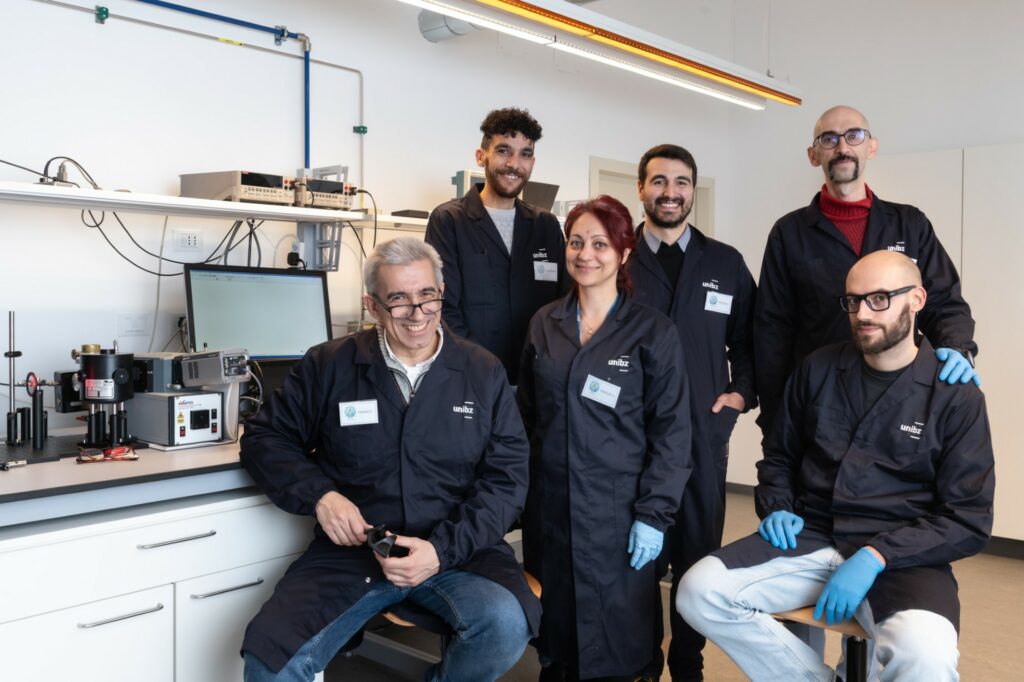
CURRENT MEMBERS
Professors
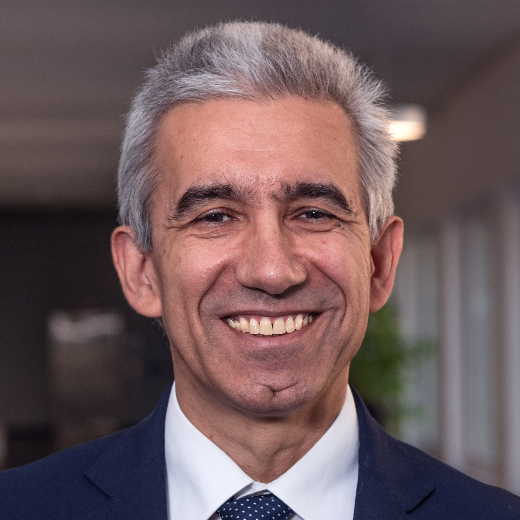
© unibz|Alexander Erlacher
Prof. Franco Cacialli
Head of the group
Received his “Laurea” degree (cum Laude) and PhD in Electronic Engineering from the University of Pisa, and after post-doctoral work at Cambridge (Department of Physics – 1994- 1996) has been a Royal Society University Research Fellow in the period 1996-2004, first at Cambridge until 2001, then at University College London (UCL), where he joined the Department of Physics and Astronomy and the London Centre for Nanotechnology (LCN, www.londonnano.ucl.ac.uk).
Appointed as Lecturer in Physics in 2001, promoted to Reader in 2003, and then Professor of Physics in 2005, Franco developed his research interests on the physics and application of advanced functional materials to light-emitting and photovoltaic diodes, as well as to field-effect transistors. Emphasis was placed on the properties of the electrode-semiconductors interface, as an aspect of fundamental importance in virtually all device applications. Research interests also included supramolecular architectures for the control and tailoring of intermolecular interactions, and thus of organic semiconductors (OS) photophysics. Strong interests also included high-resolution nanolithography by means of the scanning near-field optical microscope (SNOM) or the scanning thermal microscope (SThM). Alongside collaborators Franco and his group have developed the science and technology of near-infrared (NIR) organic light-emitting diodes (OLEDs), especially those based on heavy metal-free, non-toxic and sustainable materials (Adv. Funct. Mater. 29, 1807623, 2019). Alongside collaborators they have also developed tattooable OLEDs (Adv. Electron. Mater. 21, 2001145, 2021 https://doi.org/10.1002/aelm.202001145) which have elicited significant media coverage.
Franco Cacialli was elected a Fellow of the Institute of Physics (FinstP, 2001), and of the American Physical Society (2009), and was a recipient of a Royal Society Wolfson Research Merit Award (2015-2019). He also served as founding co-director of the London Institute for Advanced Light Technologies (http://london-light.org) in the period 2019-2022, before taking up his new position at the Free University of Bolzano.
Researchers/Technologist

© unibz|Alexander Erlacher
Dr. Manuela Ciocca
Assistant professor
Received her M.Sc. degree in Medical Engineering from University of Rome TorVergata (Italy) in 2016. Her master’s thesis focused on developing and testing organic semiconducting polymers and thin films for bio-hybrid interfaces with retinal system to develop Artificial Retina models. She obtained her Ph.D. degree in Electronic Engineering in 2020 from University of Rome TorVergata (Italy) with a thesis entitled “Conjugated polymer photosensitive platforms for Artificial Retina and light control of living cells”. During the three Ph.D. years she worked at CHOSE (Center of Hybrid and Organic Solar Energy, Rome) and one year (2nd year of Ph.D.) at University of Surrey (UK) as visiting Ph.D. on the development of an inkjet printed polymeric Artificial Retina (project funded by Lazio Region-TORNOSUBITO program). She won the ITWIIN (Italian Women Inventor&Innovator) Awards-Special Mention MaterialConneXion-Best Innovative woman 2016, and the EIWIIN (European International Women Inventors&Innovators) Special Recognition Award 2017 for ingenious and innovative achievements.
Dr. Ciocca is currently Assistant Professor at the Free University of Bozen-Bolzano (Italy), working in the PRIME Research Group at the Faculty of Engineering.

© unibz|Alexander Erlacher
Dr. Soufiane Krik
Technologist
Received his B.Sc. degree in Physics in 2015 and subsequently completed his M.Sc. degree in Physics in 2017, both from the Department of Physics within the Faculty of Science at the University of Casablanca, Morocco. He successfully defended his doctoral dissertation to earn his Ph.D. degree in Physics in July 2021 from the University of Ferrara at the Sensor and Semiconductor Laboratory, in collaboration with the Micro Nano Facility at the Bruno Kessler Foundation in Trento. Following the completion of his doctoral studies, he held positions as a postdoctoral researcher at the Sensing Technologies Lab of the Free University of Bolzano (Italy) from 2021 to 2023 and as a junior university researcher from 2023 to 2024 at the same institution.
Currently, his research interests revolve around the development of electronics on flexible substrates and printing techniques employed in fabricating sensors, devices, and circuits, with a specific emphasis on photonics and optoelectronics devices.
Post-Docs/Research assistants

Dr. Mallikarjun Madagalam
Received his Bachelor ofTechnology (distinction) in Electronics and Communication Engineering from Rajiv Gandhi University of Knowledge Technologies, Nuzvid (India) in 2014. He obtained his 1st master’s degree in Electronics in 2017 from Halmstad University and worked as a research engineer for a short period in Sweden. During his master thesis at Lund University, he was awarded “Global Swede” by Swedish ministry of foreign affairs and the Swedish Institute (SI) on May 18th, 2016, in Stockholm. He moved to Italy in 2017 and received his 2nd master’sdegree in Nanotechnologies for ICTs from Politecnico di Torino in 2020 by performing his master thesis on “bismuth oxynitrates based electrochemical sensors” in Bio/CMOS interfaces Lab of prof. Sandro Carrara at EPFL in Switzerland. Later, he worked as a research assistant for a year in Sensing Technologies Lab of prof. Paolo Lugli at Free University of Bolzano. He received his PhD (cum laude) in Electrical, Electronics and Communication Engineering from Politecnico di Torino by successfully defending his PhD thesis “Enhancing the Electron Transfer at Electrochemical Interfaces by Spinel Oxide-Nanostructures” in 2025. During his PhD he spent a period in the research group of prof. Irene Taurino at KU Leuven, Belgium and worked on potentiometric pH and amperometric dissolved oxygen sensing using ZnO and ZnFe2O4 nanoparticles, as well as a period in Bio/CMOS interfaces Lab at EPFL where he focused on non-enzymatic electrochemical sensing of anticancer drugs (5-FU, etoposide, and methotrexate). Later, he held a 6-month postdoctoral position at Politecnico di Torino focusing on photocatalytic color degradation of organic stains (red wine, lemon tea, and coffee) by ACE products (Fater group) integrated with Fe-doped TiO2 nanoparticles. He started his research contract at Free University of Bolzano in July 2026.
Currently, his research focuses on the development of biocompatible and bioresorbable batteries and optoelectronic devices for electronic medicine, avionic, and satellite applications.
PhD students

Mr. Javad Shoae Gharehbagh
Received his B.Sc. in Physics (Solid-state and Electronics) from the University of Tabriz (2011–2015) and his M.Sc. in Solid-state Physics from Shahid Beheshti University (2015–2018). During his Master’s studies, he worked on the fabrication, characterization, and magnetoresistance of magnetic/non-magnetic multilayer nanowires. After graduation, he worked as a junior researcher in the Nano-Physics and Spintronics Group at Shahid Beheshti University’s Department of Physics and later as a lab assistant until 2023. Beyond his academic pursuits, Javad has significant experience in mechanical design and 3D printing. He has applied this expertise to design and create lab instruments, such as the mechanical components of an ellipsometer.
Currently, he is pursuing a Ph.D. under the supervision of Professor Franco Cacialli at the Faculty of Engineering at the Free University of Bozen-Bolzano. His Ph.D. project focuses on developing biocompatible, biodegradable, and bioresorbable infrared and near-infrared organic light-emitting diodes (OLEDs).

Miss. Mahsa Eynollahi
Received her M.Sc. degree in Materials Engineering from Shiraz University of Technology, in 2019. Her undergraduate studies were in the same field, as well. During her M.Sc. studies, he worked on a project on the fabrication of perovskite solar cells using as synthesised and characterized inorganic semiconductors, in collaboration with University of Tabriz. Her foundation of multidisciplinary research approach is laid by the combination of advanced material synthesis techniques with optoelectronic applications. Following her graduation, she joined the Nanomaterials group at the University of Tabriz as a junior researcher and laboratory assistant, where she was involved in the development of photocatalytic materials aimed at environmental remediation. Her research focused on designing and optimizing semiconductor-based photocatalysts for the degradation of organic and pharmaceutical pollutants in aqueous solutions. Currently, she is a PhD candidate at the Free University of Bozen-Bolzano, PRIME research group, working under the supervision of Professor Franco Cacialli.
Collaborators
Internal collaborations

BITZ unibz fablab
Dott. Hannelore Shwabl
Per. Ind. Uwe Federer

Climatic Chamber Lab
Faculty of Agricultural, Environmental and Food Sciences
Competence center fo plant health
Free University of Bozen-Bolzano
Prof. Tanja Mimmo

Flexible Electronics Lab
Faculty of Engineering
Free University of Bozen-Bolzano
Prof. Niko Münzenrieder

Fluid Machines and Energy Systems
Faculty of Engineering
Free University of Bozen-Bolzano
Prof. Massimiliano Renzi

Micro4Food
Faculty of Agricultural, Environmental and Food Sciences
Free University of Bozen-Bolzano
Prof. Marco Gobbetti

Media Interaction Lab
Faculty of Engineering
Free University of Bozen-Bolzano
Prof. Michael Haller

Sensing Technologies Lab
Faculty of Engineering
Free University of Bozen-Bolzano
Prof. Paolo Lugli
Prof. Luisa Petti
External collaborations

Group Name
Faculty
Free University of Bozen-Bolzano
Prof.
alumni
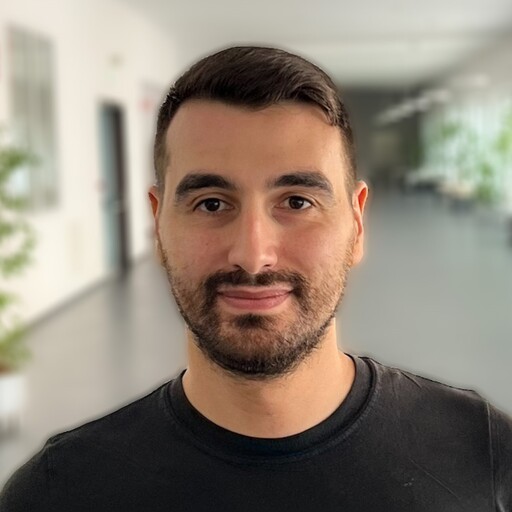
Dr. Michele Pompilio